Last updated July 20, 2026 Reviewed by veterinary experts
Supplement Review
Curcumin (turmeric)
for Joint Health in Dogs
There was weak evidence to support the use of curcumin (turmeric) in dogs with arthritis or joint disease
-

Authored by
Jonathan Schaefer , MSc, DVM, DACVECCBoard Certified Veterinary Emergency and Critical Care
-

Evidence grade
Limited Evidence
Few available clinical trials in dogs, some supporting laboratory data
About our grading systemEvidence Snapshot
-
Best supported for
Joint health & mobility
-
Evidence quality
Low
-
Amount of research
Limited
-
Safety
Low risk
-
Observed benefit
Mixed results
Evaluated for dogs across 12 peer-reviewed references.
Key Takeaways for Pet Owners
- No robust canine clinical trial has evaluated curcumin alone for arthritis. Available studies used combination products, making it impossible to isolate curcumin's effect.
- Poor oral bioavailability is a significant practical limitation. Very little intact curcumin is absorbed after ingestion in dogs without bioavailability-enhancing formulations.
- Laboratory findings are encouraging, but lab results have not translated to demonstrated clinical benefit in dogs.
- Generally considered safe at studied doses.
- Current evidence supports classification as an unproven adjunct to arthritis management, not a proven therapy.
- Larger, well-designed trials evaluating curcumin in isolation are needed before stronger conclusions can be drawn.
Evidence Review (Deep Dive)
Explore the science behind the evidence. Each section expands to reveal the full review.
Does supplementation with tumeric/curcumin result in improvement in signs of arthritis or joint health in dogs?
Clinical Summary The evidence-based bottom line and the patients most likely to benefit.
Does Turmeric Help Dogs with Arthritis? What the Evidence Actually Shows
Curcumin, the active compound in turmeric, has biologically plausible anti-inflammatory mechanisms and some encouraging early signals in dogs, including a possible NSAID-sparing effect, but the canine clinical evidence is genuinely preliminary. No veterinary study has yet demonstrated consistent, objective improvement in gait or force-plate measures, most trials use combination products that obscure curcumin’s individual contribution, and standard turmeric powder is poorly absorbed. The honest reading is cautious optimism paired with tempered expectations: a reasonable adjunct to explore, not a proven standalone treatment.
Biology & Mechanism How the ingredient works in the body and why its source matters.
What Is Curcumin and Where Does It Come From?
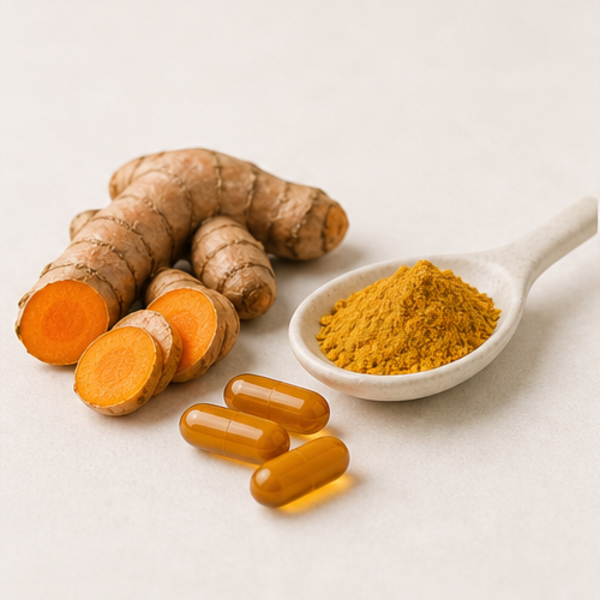
Turmeric is a spice derived from the root of the Curcuma longa plant. Its primary active compound is curcumin, a polyphenol that has drawn substantial scientific interest for its anti-inflammatory and antioxidant properties. Most products marketed for joints are standardized to curcumin or curcuminoids, and many now use specialized formulations designed to overcome curcumin’s most important practical limitation, which is poor absorption.
How Might Curcumin Reduce Joint Inflammation? (Mechanism of Action)
In laboratory settings, curcumin inhibits several inflammatory pathways central to osteoarthritis. It is thought to suppress NF-κB signaling, a master regulator of the inflammatory response; to reduce production of TNF-α, a key cytokine that drives joint inflammation; and to inhibit matrix metalloproteinases (MMPs), the enzymes that degrade joint cartilage (Henrotin et al., 2022; Mobasheri & Henrotin, 2021). These mechanisms are real and scientifically plausible. The critical question is whether they translate into meaningful clinical benefit when curcumin is given by mouth to a dog with arthritis, because laboratory findings do not always survive contact with the complexity of a living patient.
Why Is This Rationale Relevant to Canine Osteoarthritis?
Canine osteoarthritis is driven by inflammation and progressive cartilage breakdown, and curcumin’s proposed targets, NF-κB, TNF-α, and MMPs, sit squarely within those processes. On paper this makes curcumin a logical candidate for dampening the inflammatory cycle that maintains joint pain. The gap between this rationale and proven benefit comes down to whether enough active curcumin reaches the joint and whether the molecular effects produce changes a dog actually feels, which is where absorption and the clinical data become decisive.
Bioavailability & Formulations Forms, absorption, stability, dosing, and product-quality factors.
Why Does Bioavailability Matter So Much? (Absorption and Formulation)
Poor bioavailability is the single most important practical limitation of curcumin as a supplement, and it is central to interpreting the evidence. Standard curcumin is poorly absorbed from the gastrointestinal tract, rapidly metabolized, and quickly eliminated, so very little reaches the tissues where it is needed. This has driven the development of enhanced formulations, including co-micronization with other compounds, nanoparticle delivery systems, and combination with piperine (black pepper extract) to slow metabolism. The practical consequence is that a study using a highly bioavailable formulation may not be applicable to a standard turmeric powder on a store shelf, and the enhanced formulations are generally favored in the research. Bioavailability therefore is not a footnote here; it determines whether a given product has any realistic chance of delivering the effects seen in the lab.
Clinical Evidence in Dogs What controlled studies and systematic reviews found.
What Does the Clinical Evidence in Dogs Show?
The canine clinical trials are few, mostly small, often based on combination products, and frequently carry conflicts of interest, so they should be read carefully.
- Curcuminoids + hydrolyzed collagen + green tea extract (randomized, double-blind, placebo-controlled, 3 months): Objective measures, including force-plate analysis and serum biomarkers, showed no significant difference between groups. However, owner-reported pain remained stable in the supplement group while worsening in the placebo group, and the ability to rise from lying down improved significantly with the supplement. Limitations: funded by employees of the product manufacturer, the curcumin dose was not clearly reported, and it was a combination product (Comblain et al., 2017).
- Green-lipped mussel + curcumin + blackcurrant (crossover trial): COAST scores improved from baseline but not significantly versus placebo, with no objective force-plate differences and several non-responders (Corbee, 2022).
- Palmitoyl-glucosamine co-micronized with curcumin (maintenance therapy after meloxicam): The most clinically interesting finding. Based on owner assessment, 90 percent of dogs that had responded to full-dose meloxicam could reduce it to as little as 25 percent of the original dose without pain worsening, and 75 percent showed no pain increase ten weeks after meloxicam was fully withdrawn, with significant decreases in pain-severity scores through the study. Independent replication is needed and a conflict of interest is present (Della Rocca et al., 2023).
- Curcumin C3 complex + glucosamine and chondroitin (mechanistic in vivo study): Reported a 24.5 percent reduction in serum MMP-3 and a 20.8 percent decrease in serum TNF-α, alongside improved subjective pain scores. This is primarily a laboratory study rather than a rigorous clinical trial and carries a conflict of interest (Zheng et al., 2025).
Taken together, the canine studies suggest curcumin can produce genuine biological signals of reduced inflammation and that some dogs show owner-perceived improvement in comfort, with a possible NSAID-sparing effect as the most clinically meaningful signal. What the evidence does not yet support is equally important: no canine study has shown consistent, objective improvement in gait or force-plate measures, the research standard for mobility, and responses are variable across dogs.
What Do Human and Laboratory Studies Add? (Translational Support)
The human literature is more developed and provides useful biological context, though it cannot be applied directly to dogs. Several randomized controlled trials in people with knee osteoarthritis have found that curcumin reduces pain and improves function compared with placebo, in some studies performing comparably to low-dose NSAIDs such as ibuprofen, with meaningful analgesic and anti-inflammatory effects across multiple trials of varying quality (Paultre et al., 2021; Shep et al., 2019; Giordano et al., 2023). A larger systematic review and meta-analysis of curcumin and Curcuma longa extract across several arthritis types, pooling 29 randomized controlled trials, similarly concluded that curcumin improves symptoms and inflammation in people with arthritis (Curcuma longa arthritis meta-analysis, 2022). Dogs and humans differ in curcumin metabolism, in which joints develop osteoarthritis, and in gut microbiome composition, so the human data provide a plausible rationale for studying curcumin in dogs rather than direct evidence of canine efficacy.
At the cellular level, a study of dietary curcumin in arthritic dogs found that after 20 days the number of differentially expressed inflammatory genes in white blood cells fell to a degree comparable to NSAID treatment, with specific anti-inflammatory targets including upregulation of IkB and downregulation of TNF-α and IL-18 (Colitti et al., 2012). This is biologically interesting but is not the same as a dog walking more comfortably. Rodent studies of co-micronized curcumin have shown cartilage protection and a roughly 45 percent improvement in locomotor function, though rodent arthritis models translate imperfectly to naturally occurring disease (Gugliandolo et al., 2020). This layer of evidence supports the rationale for further research; it does not confirm clinical benefit on its own.
Safety, Quality & Limitations Adverse effects, research limitations, and unanswered questions.
What Does the Science Say About Safety and Interactions?
The safety profile of curcumin at typical supplement doses is reassuring across the studies reviewed, with no notable adverse effects reported. The main scientific caveats are about interpretation rather than toxicity: most canine studies use combination products, so attributing either benefit or any adverse effect to curcumin specifically is difficult, and curcumin can in principle affect drug metabolism, which is the basis for caution when it is combined with prescription medications. Because enhanced-bioavailability formulations increase systemic exposure, their interaction potential is less well characterized than that of poorly absorbed standard powder, and this remains an open area rather than a documented problem.
Limitations and Future Directions
The veterinary curcumin literature is early-stage. Its main limitations are the absence of any demonstrated objective gait or force-plate improvement, near-universal reliance on combination products that prevent isolating curcumin’s contribution, several conflicts of interest, and the poor and variable bioavailability of standard formulations. A specific evidence-based canine dose does not yet exist. The most useful future work would be adequately powered, independent trials of single-ingredient, well-characterized high-bioavailability curcumin using objective outcomes, along with head-to-head comparison of formulations. For now, curcumin is best understood as a biologically plausible adjunct with promising but unproven canine efficacy, and it may earn a more confident position as the research matures.
Frequently Asked Questions
Does turmeric or curcumin help dogs with arthritis?
The canine evidence is preliminary. Curcumin produces real biological signals of reduced inflammation and some owner-perceived improvement, and one study suggests a possible NSAID-sparing effect, but no canine trial has shown consistent, objective improvement in gait or force-plate measures, and responses vary between dogs (Della Rocca et al., 2023; Comblain et al., 2017).
Why is curcumin’s bioavailability a problem?
Standard curcumin is poorly absorbed, rapidly metabolized, and quickly eliminated, so little reaches joint tissue. This has driven enhanced formulations using co-micronization, nanoparticles, or piperine, and it means a study using a high-bioavailability product may not apply to a standard turmeric powder on the shelf.
Is turmeric safe for dogs?
The safety profile at typical supplement doses is reassuring across the studies reviewed, with no notable adverse effects reported. The main caveats are interpretive: most studies use combination products, and curcumin can in principle affect drug metabolism, so its interaction potential alongside prescription medications is not fully characterized.
Is the human curcumin evidence relevant to dogs?
It supports plausibility rather than proof. Human trials in knee osteoarthritis show curcumin can reduce pain and sometimes perform comparably to low-dose NSAIDs, but dogs differ in curcumin metabolism, joint distribution, and gut microbiome, so human data justify studying curcumin in dogs rather than confirming canine efficacy (Paultre et al., 2021; Giordano et al., 2023).
Compare Curcumin Products
We evaluate the science first, then help you check product quality and transparency.
No matched products are published yet
Product matches appear here only after our editorial team verifies their ingredient and quality details.
Key References
12 peer-reviewed studies- 1
Colitti M, Gaspardo B, Della Pria A, Scaini C, Stefanon B. Transcriptome modification of white blood cells after dietary administration of curcumin and non-steroidal anti-inflammatory drug in osteoarthritic affected dogs. Vet Immunol Immunopathol. 2012;147(3-4):136-146. https://pubmed.ncbi.nlm.nih.gov/22591841/ (opens in a new tab)
This evidence review received independent veterinary review.
-
Evidence first
We evaluate ingredients based on the quality and consistency of scientific evidence.
-
Veterinarian-authored
Content is written or reviewed by board-certified veterinary professionals.
-
Independent
No industry funding, sponsorships, or advertising influence our conclusions.