Last updated July 21, 2026 Reviewed by veterinary experts
Supplement Review
Green-Lipped Mussel
for Joint Health in Dogs
There was moderate evidence to support the use of Green Lipped Mussel in dogs with arthritis or mobility issues.
-

Authored by
Jonathan Schaefer , MSc, DVM, DACVECCBoard Certified Veterinary Emergency and Critical Care
-

-

Evidence grade
Moderate Evidence
Emerging evidence is promising but limited. Generally appears safe.
About our grading systemEvidence Snapshot
-
Best supported for
Joint health & mobility
-
Evidence quality
Moderate
-
Amount of research
High
-
Safety
Low risk
-
Observed benefit
Modest or preliminary benefit
Evaluated for dogs across 8 peer-reviewed references.
Key Takeaways for Pet Owners
- Multiple smaller studies showed mild, yet positive results in dogs with arthritis.
- Results may take 6-8 weeks to become noticeable.
- Green Lipped Mussel differs from other omega-3's in that it contains ETA (instead of EPA and DHA), which has potent anti-inflammatory properties.
- Optimal dosing in dogs has not yet been established
- The safety profile appears excellent with very few side effects reported across clinical studies
- It is unknown if combination GLM with other marine omega-3's would offer additive benefit. The biologic rational is supportive, though has not been evaluated in multiple trials (yet).
Evidence Review (Deep Dive)
Explore the science behind the evidence. Each section expands to reveal the full review.
Does green lipped muscle (GLM) supplementation result in clinically measurable improvements in mobility or pain relief for dogs with arthritis?
Clinical Summary The evidence-based bottom line and the patients most likely to benefit.
Can Green-Lipped Mussel Help Dogs with Arthritis? The Calibrated Bottom Line
Green-lipped mussel (GLM), the New Zealand shellfish Perna canaliculus, has a modest but reasonably consistent body of canine evidence suggesting it can improve pain and mobility in dogs with osteoarthritis, generally as an adjunct rather than a standalone treatment. Several trials report measurable benefit, including objective weight-bearing improvements, though effects are usually less potent than NSAIDs and some dogs do not respond (Bui & Bierer, 2003; Hielm-Björkman et al., 2009; Rialland et al., 2013; Eason et al., 2018). The current evidence supports symptomatic improvement rather than cartilage regeneration.
Biology & Mechanism How the ingredient works in the body and why its source matters.
What Is Green-Lipped Mussel and Where Does It Come From?
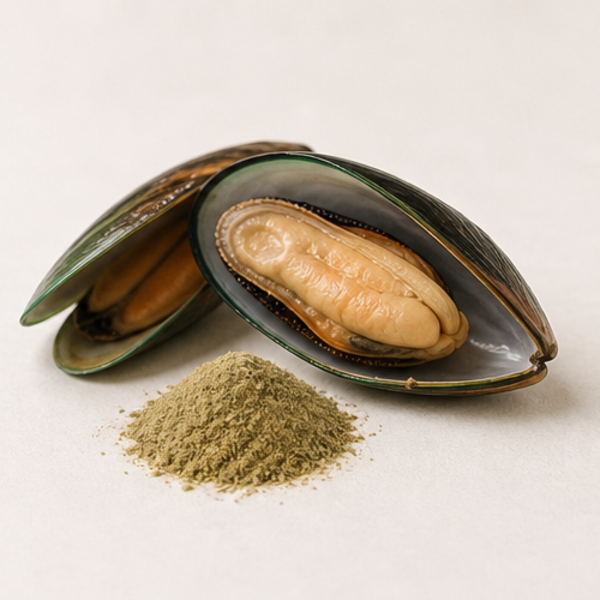
Green-lipped mussel is a marine bivalve native to New Zealand’s coastal waters, named for the green margin along its shell. Interest in it as a joint supplement traces back to observations of low arthritis rates in some coastal communities that historically consumed it. In pet products it is not fresh shellfish but a processed ingredient, supplied either as freeze-dried whole mussel powder or as a lipid (oil) extract. Research papers often refer to the species as Greenshell mussel (Eason et al., 2018). GLM products are regulated as nutraceuticals rather than medicines, so content and quality vary between brands.
How Is Green-Lipped Mussel Thought to Work? (Mechanism of Action)
Rather than acting on a single pathway, GLM is thought to work through a combination of naturally occurring compounds. Its lipid fraction contains long-chain fatty acids including EPA, DHA, and the comparatively rare eicosatetraenoic acid (ETA), which are thought to down-regulate the cyclooxygenase (COX) and lipoxygenase (LOX) pathways that drive joint inflammation (Hielm-Björkman et al., 2009). ETA is of particular interest because it appears to inhibit inflammatory enzymes in a way that may be more joint-relevant than EPA and DHA alone. GLM also supplies glycosaminoglycans, including chondroitin-type compounds, that are thought to support cartilage matrix and synovial fluid, although the oral bioavailability of these larger molecules remains under investigation (Eason et al., 2018). Some studies suggest GLM improves weight-bearing and activity through pain modulation independent of major structural change (Bui & Bierer, 2003; Cave et al., 2024).
Why Is This Rationale Relevant to Canine Osteoarthritis?
Canine osteoarthritis involves chronic pain, joint inflammation, cartilage degradation, and bone remodeling. GLM’s appeal is that its multi-component profile maps onto several of these processes at once: an anti-inflammatory lipid fraction aimed at the inflammatory component, and structural nutrients aimed at the cartilage matrix. This is a different rationale from a single concentrated omega-3 oil, and it is the basis for the idea that GLM offers joint-targeted, complementary support. Whether the structural components meaningfully reach the joint after oral dosing is the main uncertainty in this rationale.
Bioavailability & Formulations Forms, absorption, stability, dosing, and product-quality factors.
Does Form and Processing Affect the Science? (Bioavailability)
Form matters more for GLM than for a single purified compound, because the active constituents differ between preparations. Whole freeze-dried mussel powder and concentrated lipid extracts do not deliver the same balance of fatty acids, glycosaminoglycans, and other components, and processing method and heat exposure can affect the integrity of the labile lipids. Products vary widely in actual content and in whether they quantify omega-3 levels at all. A central open question is the oral bioavailability of the glycosaminoglycan fraction, since being present in the capsule is not the same as reaching the joint, an issue the review literature explicitly flags as needing resolution (Eason et al., 2018).
Clinical Evidence in Dogs What controlled studies and systematic reviews found.
What Does the Clinical Evidence in Dogs Show?
The canine literature is small but leans positive, and notably includes objective outcome measures in several trials.
- Green-lipped mussel (GLM) vs. controls (early controlled study, 6 weeks): Significant improvement in total arthritis score, with specific reductions in joint pain and swelling in the GLM group versus controls (Bui & Bierer, 2003).
- GLM (double-blinded RCT): Significant improvement in veterinary-assessed mobility and pain scores. Less potent than the NSAID carprofen but produced no detectable adverse effects, positioning it as a potential option when NSAIDs cannot be used (Hielm-Björkman et al., 2009).
- GLM-enriched diet (objective force-plate measure): Documented rising plasma omega-3 concentrations alongside improvement in peak vertical force, an objective weight-bearing measure, between day 30 and day 90. The balanced control diet also showed improvement, which was subsequently amplified by GLM (Rialland et al., 2013).
- GLM + krill oil vs. meloxicam vs. placebo (prospective RCT, 6 weeks): The combination produced benefits similar to the NSAID meloxicam, with both superior to placebo. In that trial the product was given at one capsule per 10 kg twice daily, each capsule containing 30 mg GLM and 20 mg krill oil (Kampa et al., 2024).
- Low-dose GLM extract (crossover pilot, working farm dogs): Even a low-dose extract increased peak activity measured by accelerometry (Cave et al., 2024).
- GLM + curcumin + blackcurrant combination (crossover trial): COAST scores improved versus baseline but not significantly versus placebo, with several non-responders noted, underscoring real individual variability (Corbee, 2022).
Two recurring caveats apply across the literature: several trials use combination products that make it hard to isolate GLM's specific contribution, and some are industry-funded.
How Does Green-Lipped Mussel Compare to Standard Fish Oil? (Comparative Context)
Both GLM and standard fish oil deliver EPA and DHA, but GLM differs in two ways that are relevant to its rationale. It contains ETA, a fatty acid largely absent from standard fish oils that appears particularly active against inflammatory enzymes, and it supplies a broader matrix of glycosaminoglycans, amino acids, antioxidants, and minerals rather than concentrated EPA and DHA alone (Eason et al., 2018). The current evidence does not show GLM replacing the systemic benefits of fish oil, and the two have been used together in trials without major safety problems (Rialland et al., 2013; Kampa et al., 2024). The relevant scientific caution is to avoid unintentionally stacking multiple high omega-3 products, since overlapping doses can increase the chance of gastrointestinal upset. More broadly, GLM is best understood as one component of multimodal osteoarthritis management rather than a primary therapy, sitting alongside interventions such as weight optimization and, where appropriate, NSAIDs, which carry their own evidence; in working dogs with hip osteoarthritis, for instance, an oral joint supplement and carprofen each produced only limited individual responses, underscoring that no single agent reliably addresses joint disease on its own (Alves et al., 2017).
What Does the Review and Translational Evidence Add?
Unusually for a supplement, much of the supporting evidence for GLM is already in the target species. A review of veterinary trials concluded that adding Greenshell mussel to the diet has alleviated degenerative joint disease signs in cats and chronic orthopedic pain in dogs, while explicitly calling for future work to identify which specific components and doses are responsible for the effect (Eason et al., 2018). This is a meaningful strength relative to ingredients whose case rests mainly on human or rodent data, but it is balanced by the small size and methodological variability of the individual trials.
Safety, Quality & Limitations Adverse effects, research limitations, and unanswered questions.
What Does the Science Say About Safety and Interactions?
Across the canine trials, green-lipped mussel has been well tolerated with no major adverse events reported (Hielm-Björkman et al., 2009; Eason et al., 2018). The mild effects observed are mostly gastrointestinal, such as occasional soft stool, vomiting, or decreased appetite when first introduced, along with a possible fishy odor. Because GLM is a marine shellfish product, the most important theoretical safety consideration is allergy in dogs with known shellfish or marine-protein sensitivity. From a mechanistic standpoint, the omega-3 content raises the same theoretical bleeding consideration as fish oil, which is relevant for dogs on anticoagulants or with bleeding disorders, and the lipid content is a reason for caution in dogs with a history of pancreatitis or severe hyperlipidemia. Safety has not been established in pregnant or lactating dogs. Product quality is itself a safety variable, since contaminants are possible with poor manufacturing, which is why batch testing and sustainable New Zealand sourcing are reasonable quality markers.
Limitations and Future Directions
The GLM evidence base is promising but constrained by small sample sizes, frequent use of combination and industry-funded products, variability in preparation and dosing, and documented non-responders. The single most important unresolved question, highlighted by the review literature, is which active constituents and what doses drive the effect, and how well the structural components are actually absorbed (Eason et al., 2018). Larger, independent, single-ingredient trials with standardized, quantified products and objective outcomes would do the most to firm up where GLM sits. For now, the defensible reading is that GLM is a reasonable adjunct with modest, mostly symptomatic benefit for many but not all arthritic dogs, and that the goal is improved comfort and function rather than reversal of joint damage.
Frequently Asked Questions
Does green-lipped mussel help dogs with arthritis?
The canine evidence is modest but leans positive, with several trials reporting improved pain and mobility, including objective weight-bearing gains. The benefit is generally less potent than NSAIDs, some dogs do not respond, and current data support symptomatic improvement rather than cartilage repair (Hielm-Björkman et al., 2009; Rialland et al., 2013).
How is green-lipped mussel different from regular fish oil?
Green-lipped mussel contains eicosatetraenoic acid (ETA), a comparatively rare fatty acid largely absent from standard fish oils that appears particularly active against inflammatory enzymes, and it supplies a broader matrix of glycosaminoglycans, antioxidants, and minerals rather than concentrated EPA and DHA alone (Eason et al., 2018).
Is green-lipped mussel safe for dogs with shellfish allergies?
Because it is a marine shellfish product, allergy is the main theoretical safety consideration for dogs with known shellfish or marine-protein sensitivity. Across trials it has otherwise been well tolerated, with mostly mild, transient gastrointestinal effects (Eason et al., 2018).
Can green-lipped mussel be used together with fish oil?
In published trials, green-lipped mussel has been combined with other omega-3 sources without major safety problems. The relevant scientific caution is to avoid unintentionally stacking multiple high omega-3 products, since overlapping doses can increase the chance of gastrointestinal upset (Kampa et al., 2024).
Compare Green-Lipped Mussel Products
We evaluate the science first, then help you check product quality and transparency.
No matched products are published yet
Product matches appear here only after our editorial team verifies their ingredient and quality details.
Key References
8 peer-reviewed studies- 1
Alves JC, Santos AM, Jorge PI. Effect of an oral joint supplement when compared to carprofen in the management of hip osteoarthritis in working dogs. Top Companion Anim Med. 2017;32(4):126-129. https://pubmed.ncbi.nlm.nih.gov/29525231/ (opens in a new tab)
This evidence review received independent veterinary review.
-
Evidence first
We evaluate ingredients based on the quality and consistency of scientific evidence.
-
Veterinarian-authored
Content is written or reviewed by board-certified veterinary professionals.
-
Independent
No industry funding, sponsorships, or advertising influence our conclusions.