Last updated July 21, 2026 Reviewed by veterinary experts
Food Review
Raw meat based diets
for Dogs
No long-term health benefit has been demonstrated for raw meat-based diets in dogs. Some digestibility markers improve, but this is over-shadowed by the documented infectious disease risk to both dogs and people.
-

Authored by
Jonathan Schaefer , MSc, DVM, DACVECCBoard Certified Veterinary Emergency and Critical Care
-

Reviewed by
Mei Lun Mui , DVM, DACVIM (Small Animal Internal Medicine)Board Certified Internal Medicine Specialist
-

Evidence grade
No Evidence / Risk
Multiple studies demonstrated risk of transmission of pathogenic bacteria from dogs to humans.
About our grading systemFood Evidence Snapshot
19 peer-reviewed studies
-
Best suited for
Adult dogs
-
Evidence quality
Moderate
-
Amount of research
High
-
Nutritional completeness
Varies by formulation
-
Safety
Use with caution
Practical considerations: Home-made raw diets often nutritionally incomplete, requires special handling
Key Takeaways for Pet Owners
- Raw food diets have not demonstrated a population-wide benefit and pose a significant risk of harm to both animals and humans.
- Dogs on raw diets may appear healthy yet still carry dangerous pathogens transmissible to humans, especially infants, the immunocompromised, and the elderly.
- Some dogs show improved digestibility and mild skin health markers, though it is unclear whether the raw diet or the removal of a prior allergen was responsible.
- Home-prepared raw diets are often nutritionally incomplete, or carry a very high risk of being so.
- Raw diets do not appear nutritionally appropriate for growing puppies, who need carefully balanced calcium:phosphorus ratios.
- Owners should carefully weigh the risks to their own health before choosing a raw diet.
- Commercial raw diets that are prepared with HPP are likely safer, though this is not a pathogen "kill" step and still carry risk.
- Consult both a veterinarian and a personal physician before considering a raw meat-based diet for your dog.
Scientific Background Deep Dive
Expand each available section to read the evidence and its limitations.
Does feeding a raw meat based diet (RMBD) confer short or long term benefits to dogs compared to traditional commercial diets (extruded kibble)?
This Diet Explained What defines the feeding approach and how it differs from other diets.
What it is and how it's defined
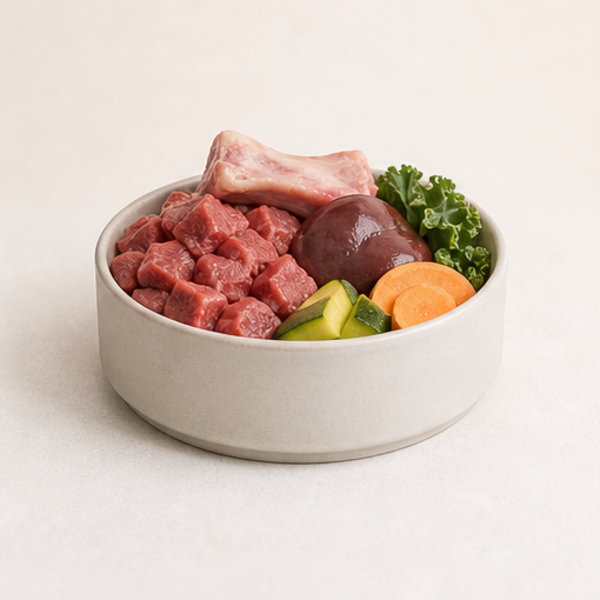
Raw meat-based diets (RMBDs) are feeding patterns built around uncooked animal tissue (muscle meat, organs, and often raw edible bone) fed in place of cooked commercial diets. The category isn't one thing.
It spans owner-assembled "BARF" (biologically appropriate raw food) diets that add vegetables, fruits, and supplements. It includes "prey-model" diets that aim to reproduce the proportions of a whole carcass and typically exclude plant matter. And it covers commercially manufactured raw products sold fresh, frozen, or freeze-dried.
For this review the variation that matters most is the split between home-prepared and commercial preparations, and between processed and unprocessed product (say, high-pressure-processed versus untreated raw). That variation drives both nutritional adequacy and microbiological risk, and it's unevenly studied.
Nutritional Completeness / Safety Nutrient adequacy, contamination, handling, and safety concerns.
Nutritional completeness
The dominant nutritional concern with RMBDs is imbalance, not gross starvation. Home-prepared raw diets are nearly universally incomplete or at high risk of being so, and commercial raw isn't exempt either.
In one Italian analysis of ten commercial RMBDs, every product showed at least one nutrient concern, with high fat contents (mean 69, range 33 to 95 g/Mcal) that correlated negatively with protein (Vecchiato, 2022). High fat is a recurring signature of the category (Lyu, 2025).
The mineral picture is where things get genuinely nuanced. A recent cohort (von Lindeiner, 2026) found that RMBD-fed dogs were leaner, with lower body condition scores (median 5 versus 6) and lower energy intake than commercial-diet dogs, and fewer overfeeding and obesity problems. The authors flagged that as a possible advantage.
In the same dogs, though, the calcium-to-phosphorus (Ca:P) ratio was lower (median 1.0) and failed to meet the recommended 1.4, versus 1.4 in commercial diets. Estimated calcium, phosphorus, sodium, and magnesium intakes were lower (though close to recommendations), while commercial diets frequently supplied more than twice the recommended calcium, phosphorus, and sodium.
RMBD-fed dogs also had lower serum iodine, copper, zinc, and manganese. The authors concluded that these imbalance concerns warrant investigation even without clinical deficiency signs.
Ca:P is the ratio that matters most here because it's most consequential in skeletal development, and reviews consistently note that raw diets may deliver an improper Ca:P for growing animals (Główny, 2024).
On the additive question, a review found that evidence doesn't substantiate that AAFCO-approved additives and preservatives cause harm, and that processing effects vary by product (Jobe, 2025). One caution for readers comparing fiber claims across diets: crude fiber (a proximate-analysis figure) isn't the same as total dietary fiber, and the two shouldn't be read interchangeably.
Safety and microbiological risks
This is the reason the diet is graded F. Microbiological surveys across Europe and North America consistently detect pathogens in a proportion of raw pet food samples, including fresh-frozen commercial product (Davies, 2019).
In 25 commercial raw diets, one survey found the following (Weese, 2005):
- Coliforms in all of them
- E. coli in 64%
- Salmonella in 20%
- Clostridium perfringens in 20%
- Toxigenic C. difficile in one
A UK study found raw meat diets carrying E. coli and Enterobacteriaceae above 5,000 CFU/g. Antimicrobial-resistant, ESBL, and third-generation-cephalosporin-resistant E. coli were isolated from 39%, 14%, and 16% of raw samples respectively, and S. enterica from 5%, while cooked kibble yielded no Enterobacteriaceae at all (Morgan, 2024).
Raw pet food commonly exceeds hygiene thresholds for Enterobacteriaceae and often encodes resistance to critically important antibiotics such as extended-spectrum cephalosporins (Davies, 2019).
Other agents documented in the category include the following (Davies, 2019); (Fredriksson-Ahomaa, 2017); (Nemser, 2014):
- Listeria monocytogenes
- Shiga-toxin-producing E. coli
- Toxoplasma gondii
- Brucella suis
- Campylobacter
- Enteropathogenic Yersinia
The antimicrobial-resistance dimension isn't incidental. A systematic review found raw diet to be among the most-investigated risk factors for antimicrobial-resistant Enterobacterales carriage, with a significant association in 9 of 14 studies (Karalliu, 2024).
The zoonotic hazard is where the concern gets sharpest. A genomic-epidemiology investigation traced a drug-resistant Salmonella cluster of 20 human cases, half of them infants, to dogs fed RMBD as the major identified source, with asymptomatic dogs acting as carriers, limited treatment options, and possible environmental persistence (Bernaquez, 2025).
That's the heart of the human-health concern: a dog on raw can look entirely healthy while shedding pathogens transmissible to people. Multiple sources accordingly advise against feeding raw in households with young children, the elderly, or immunosuppressed individuals (Weese, 2005); (Davies, 2019).
Strict handling, surface hygiene, and contamination control aren't optional refinements. They're the safeguards that determine whether the microbiological risk is contained, and owner surveys suggest many raw feeders don't know about these risks to either animal or human health (Morelli, 2019).
Clinical Evidence Reviewed What controlled studies and evidence reviews found.
Claimed benefits and what the evidence shows
Proponents claim improved digestibility, better stool quality, favorable microbiome shifts, and improvements in skin, coat, and dental markers. The controlled and observational literature offers partial, low-strength support for some of these.
- (Algya, 2018) Feeding trials in healthy adult dogs found raw and lightly cooked diets highly palatable and digestible, with reduced blood triglycerides, modified microbiota, lowest fecal pH, and higher fecal ammonia. Short-duration feeding trial, healthy adults only.
- (Sandri, 2017) Raw feeding modified fecal microbial composition and fermentation end products relative to commercial diets. Small, short-duration trial; a microbial shift isn't itself a health outcome.
- (Hiney, 2021) A slight improvement in a composite dental/ear/skin score in RMBD versus kibble-fed dogs (P=0.03). Cross-sectional and confounded, since RMBD owners also used more supplements and more sporting activity.
- (Hemida, 2021) An observational study linked puppyhood diet to owner-reported adult allergy and atopic skin signs. Observational, owner-reported, and confounded, which underscores that any skin benefit is hard to attribute to raw itself.
- (Jobe, 2025) A review found evidence doesn't substantiate that AAFCO-approved additives or preservatives cause harm, and that processing effects vary. Narrative review, not a benefit demonstration for raw.
- (Lyu, 2025) A broad review found limited evidence for possible support of body condition, stool quality, microbiome change, and metabolic and anti-inflammatory signals. Set against considerable risks and rarely studied variation in diet type, processing, and storage.
The grade lands at F, and not because every claimed effect is absent. Some digestibility and skin-marker signals are real.
It lands at F because there's no demonstrated population-wide benefit, the supportive data are short-duration, observational, and confounded, and they sit opposite well-documented and serious risks to both animals and humans.
This section describes the evidence. It doesn't recommend the diet.
Biologic Rationale Proposed mechanisms and how well they translate to health outcomes.
Biological rationale and plausibility
The proposed rationale is an ancestral or "natural" one: that dogs are adapted to the raw, whole-prey diet of their wolf ancestors, and that cooking and processing degrade nutrition and physiology.
This is a hypothesized mechanism, not a demonstrated one, and it's weakened by a basic fact. Dogs aren't wolves. Domestication reshaped canine digestive physiology, and when dogs are switched to raw, their fecal microbiota only partially converges toward the wolf profile (Xu, 2021).
Some downstream effects are plausible and observed (a lower fecal pH, altered fermentation), but the leap from "raw resembles ancestral feeding" to "raw is therefore healthier" isn't supported by outcome data. The gap between a plausible mechanism and a demonstrated clinical benefit stays wide.
Variation within the category
Variation is central to interpreting every finding above. Commercial and home-prepared raw differ in nutritional control, and home-prepared is where incompleteness is most common (Główny, 2024).
Processing matters enormously for safety. High-pressure processing can reduce Salmonella to below detection under several in-vitro conditions with little effect on color, which offers a route to safer product (Serra-Castelló, 2023), so an HPP-treated commercial raw and an untreated home batch aren't equivalent hazards.
Meat source, storage temperature, and whether product is fed frozen or thawed further modulate contamination. Because most studies don't disaggregate these factors, findings from one preparation can't be assumed to hold for another, a limitation that applies to both the benefit and the risk literature.
Practical Considerations Cost, preparation, sourcing, transition, and household factors.
Special situations
Two situations warrant particular caution. Growing puppies require a controlled Ca:P ratio for normal skeletal development, and raw diets, especially the lower Ca:P profiles documented in RMBD cohorts, may not reliably supply it, which makes raw a poor fit for growth (von Lindeiner, 2026); (Główny, 2024).
Early-life diet may also bear on later skin outcomes, though observational puppyhood-diet work reporting owner-recorded adult allergy and atopy signs is confounded and can't establish raw as protective (Hemida, 2021).
Second, households with infants, elderly people, or immunocompromised individuals carry elevated risk from the zoonotic and antimicrobial-resistance hazards described above, and multiple sources advise against raw feeding in these homes (Weese, 2005); (Davies, 2019). Imbalanced raw has also been linked in review to reproductive and endocrine effects, including poor semen quality, estrus inhibition, and hyperthyroidism from thyroid-tissue-containing neck meat (Główny, 2024).
Cost and practical burden
Compared with conventional commercial diets, raw feeding carries a high practical burden. Cost is high, and the storage and handling demands are stringent: frozen storage, cold-chain maintenance, dedicated preparation surfaces, and disciplined contamination control to protect the household.
These handling requirements aren't just inconvenient. They're the mechanism by which the microbiological risks are contained or not, which places a meaningful and ongoing operational load on the caregiver.
Limitations / Future Directions Research limitations and the questions that remain unanswered.
Limitations and future directions
The evidence base is moderate in quantity but low in quality, dominated by observational, cross-sectional, and retrospective work with short durations, small samples, and pervasive confounding. Raw-feeding owners differ systematically in supplement use and activity, which muddies any benefit signal (Hiney, 2021).
Most studies fail to separate the many sub-types of raw diet by formulation, processing, and storage, so results generalize poorly, and some contamination findings may not translate across countries or regulatory settings (Fredriksson-Ahomaa, 2017). No controlled trial has demonstrated a population-wide health benefit that offsets the documented risks.
Priorities for future work include adequately powered, longer-duration controlled trials that stratify by preparation and processing (including HPP), standardized nutritional analysis of commercial and home-prepared products, and continued One Health surveillance of antimicrobial-resistant organisms in raw-fed animals and their households.
Frequently Asked Questions
Can I get sick from feeding my dog raw food?
Yes. People have contracted illness linked to dogs fed raw diets. A genomic investigation traced a cluster of 20 drug-resistant Salmonella infections in humans, half of them infants, to dogs fed raw meat-based diets as the major identified source (Bernaquez, 2025). Dogs can shed such pathogens while appearing perfectly healthy, and raw pet food frequently carries Salmonella, E. coli, Listeria, and antimicrobial-resistant bacteria (Davies, 2019); (Weese, 2005). Careful handling and hygiene reduce this risk but don't eliminate it.
Is raw dog food safe for puppies?
Raw diets, particularly home prepared, are generally not appropriate for growing puppies. Puppies need a controlled calcium-to-phosphorus ratio for healthy bone development, and raw diets have been documented with ratios below the recommended 1.4 (median 1.0 in one cohort), along with lower intakes of several minerals (von Lindeiner, 2026); (Główny, 2024). Combined with the microbiological risks, this makes raw a poor choice during growth, and a veterinarian should guide any young animal's diet.
Does freezing raw dog food kill bacteria?
No. Freezing doesn't reliably kill the bacteria of concern. Some studies report lower contamination detectable by culture in frozen raw diets, but molecular testing still finds pathogens present, and frozen commercial products remain a documented Salmonella source (Fredriksson-Ahomaa, 2017); (Davies, 2019). High-pressure processing, not freezing, is the treatment shown in vitro to reduce Salmonella below detection (Serra-Castelló, 2023).
Do vets recommend raw diets?
The evidence doesn't support a general veterinary recommendation for raw diets, which is why this review grades them F. There's no demonstrated population-wide benefit, home-prepared raw is nearly universally nutritionally incomplete or at high risk of being so, and the diet poses serious documented risks to both animals and humans (Lyu, 2025); (Główny, 2024); (Bernaquez, 2025). While some veterinarians may condone a raw diet, the major veterinary associations such as WSAVA, AVMA, and AAHA caution heavily against feeding a raw diet. Our specialist panel universally recommends against feeding a raw diet due to the risks to both human and pet health. Anyone considering raw feeding should consult both a veterinarian and, given the zoonotic hazards, a physician.
What is HPP and does it make raw food safer?
High pressure processing (HPP) is a cold pasteurization method that applies extremely high pressure to sealed packaged food to reduce bacteria without cooking it, which is why manufacturers use it on raw diets that are meant to stay uncooked. In a laboratory study, HPP was able to significantly reduce the amount of salmonella in certain instances (Serra-Castelló et al., 2023). Pathogen reduction is not the same as elimination, and HPP is not considered a bacterial "kill" step, so safe handling and storage still matter. HPP also does nothing to address the separate concern of nutritional imbalance, which has been documented in certain commercial raw products independently of contamination (Vecchiato et al., 2022).
Find the Right Food for Dogs
Compare complete diets using published nutrition and manufacturer-quality criteria.
No foods are linked to this review yet
The finder remains available for broader, criteria-based browsing without implying an editorial recommendation.
- Compare nutrition and ingredients
- Filter by life stage and dietary needs
- See evidence-based criteria
Key References
19 peer-reviewed studies- 1
Algya KM, Cross TL, Leuck KN, et al. Apparent total-tract macronutrient digestibility, serum chemistry, urinalysis, and fecal characteristics, metabolites and microbiota of adult dogs fed extruded, mildly cooked, and raw diets. J Anim Sci. 2018. https://pubmed.ncbi.nlm.nih.gov/29893876/ (opens in a new tab)
-
Evidence first
Diets are evaluated by the quality and consistency of scientific evidence.
-
Veterinarian-authored
Published credits identify the veterinary authors and reviewers for each review.
-
Independent
No industry funding, sponsorships, or advertising influence the conclusions.